GPS Tracking for Security Guards: Why It Matters and How to Use It
A complete guide to GPS tracking for security guards — how real-time location, geofencing, and proof-of-presence reports improve accountability, win contracts, and build client trust.
In the security industry, knowing where your guards are isn’t a nice-to-have — it’s the difference between winning a contract and losing it. GPS tracking for security guards has gone from a premium add-on to a baseline expectation, and the companies that use it well are the ones clients keep renewing with.
This guide covers what GPS tracking actually does for a security operation, how geofencing automates compliance, and how to turn location data into proof that wins business.
What Is GPS Tracking for Security Guards?
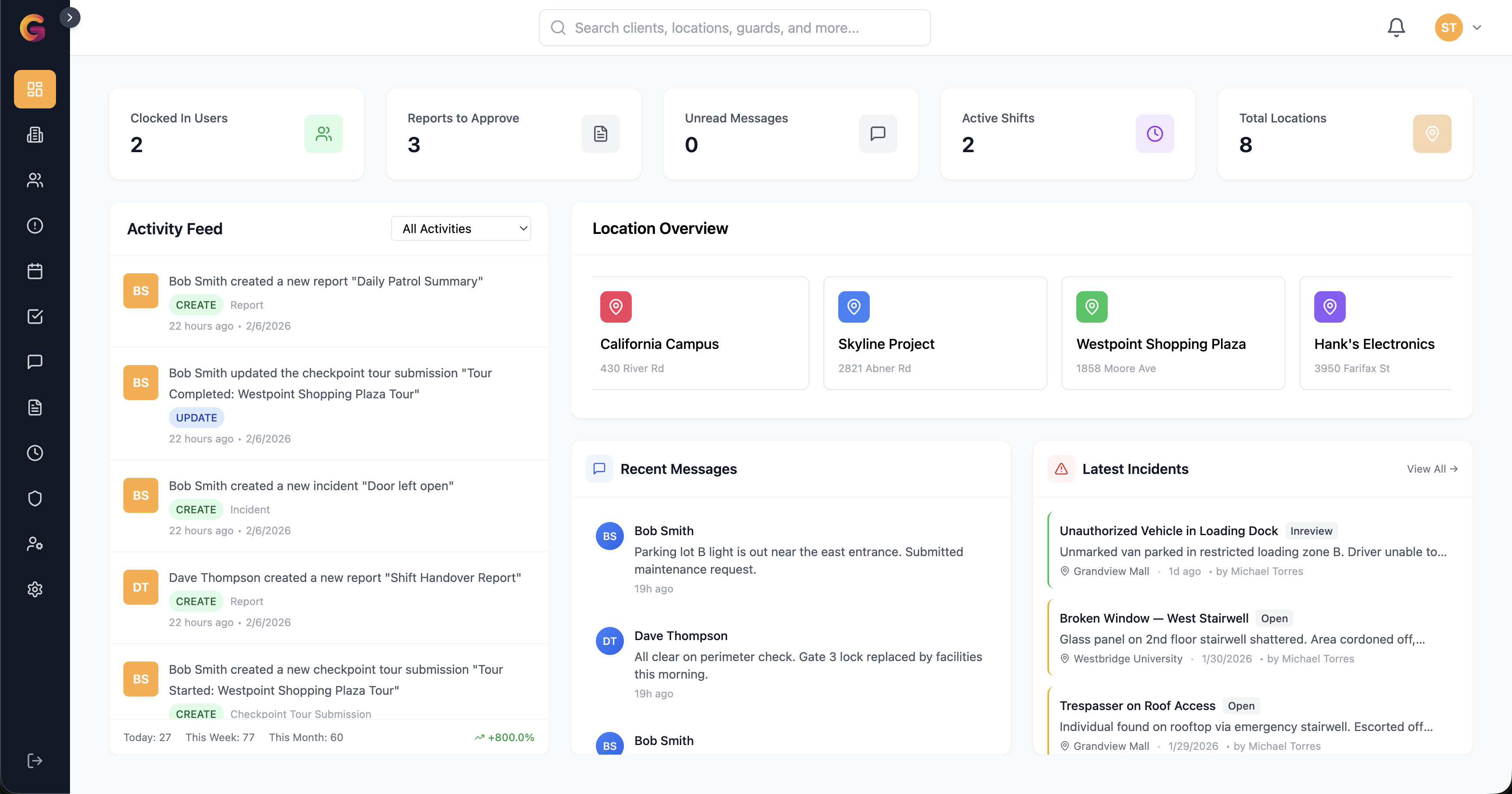
GPS tracking uses the location services in a guard’s phone (or a dedicated device) to record where they are while on shift. In a modern platform like GuardTrac, that location feeds a live map for dispatchers, time-stamps every clock-in and checkpoint scan, and builds an auditable record of patrols.
It answers the three questions every security manager — and every client — eventually asks:
- Was a guard actually on-site?
- Did they complete their patrol rounds?
- Can you prove it?
Without tracking, the honest answer is usually “probably.” With it, the answer is a timestamped, GPS-verified log.
Accountability at Every Level
When guards know their locations are recorded, punctuality and route adherence improve almost immediately. But the real value is that GPS creates a transparent record that benefits everyone in the chain:
- Guards can prove they were on-site and completed their rounds — protecting themselves from false complaints.
- Managers can verify coverage without calling every site every hour.
- Clients get peace of mind that the sites they’re paying to protect are actually being patrolled.
Accountability isn’t about micromanaging your team. It’s about removing the ambiguity that causes disputes in the first place.
Real-Time Visibility and Faster Response
With a live map view, supervisors can see every active guard’s position as it happens. That visibility changes how you run operations:
- Faster incident response — dispatch the nearest available guard instead of guessing who’s closest.
- Immediate awareness of no-shows so you can fill a coverage gap before the client notices it.
- Smarter resource allocation across multiple sites, especially when you’re stretched thin.
When something goes wrong at 2 a.m., the difference between a live map and a stack of paper logs is the difference between a controlled response and a scramble.
Geofencing: Automated Compliance
Geofencing takes GPS a step further by drawing virtual boundaries around each job site. Once those zones are set, the system enforces them automatically:
- Verify clock-ins happen at the right location — no more guards clocking in from the parking lot down the street, or worse, from home.
- Get alerts when a guard leaves a designated area during a shift.
- Generate proof-of-presence reports that show, site by site, exactly when coverage started and ended.
This is where GPS stops being a monitoring tool and becomes a compliance engine. It eliminates buddy punching, enforces shift boundaries, and does it without anyone having to manually check.
Turning Location Data Into Won Contracts
Here’s the part most companies underuse: GPS data is a sales tool.
When you can hand a prospective client a clean report showing exactly when and where their sites were patrolled — down to each checkpoint scan — you’re offering something most competitors can’t. Detailed patrol logs and proof-of-presence reports become the proof points that:
- Win competitive bids against companies still using paper
- Justify your rates when a client questions value
- Retain accounts at renewal time, because the client can see what they’re paying for
In an industry where trust is the product, verifiable data is your strongest pitch.
Addressing the Privacy Question
Guards sometimes worry that GPS tracking means being watched 24/7. Set expectations clearly: tracking is active only during shifts, it exists to protect guards as much as managers, and it creates the record that defends them when a client makes a baseless complaint. Framed honestly, most guards come to see it as a benefit, not surveillance.
How GuardTrac Handles GPS Tracking
GuardTrac builds GPS into the core of daily operations rather than treating it as an afterthought:
- GPS-verified clock in/out with geofence validation to stop buddy punching
- Live map view of every active guard for dispatch
- QR, NFC, and GPS checkpoint tours that verify patrol routes were actually walked
- Incident reports stamped with photo, GPS location, and time — and they work even offline, syncing when the guard regains signal
- Exportable reports you can share directly with clients
It all runs from the guard’s phone through the GuardTrac mobile app, with everything visible in real time from your dashboard.
Frequently Asked Questions
Does GPS tracking work without cell signal? Yes. With GuardTrac, guards can still scan checkpoints and file incident reports offline; the data syncs automatically once they’re back in coverage.
Can guards fake their location? Geofence validation ties clock-ins to the physical site boundary, which blocks the most common workarounds like clocking in from off-site.
Is GPS tracking legal for employees? Tracking employees during working hours on company-assigned tasks is broadly permitted, but you should always disclose it clearly and check the rules in your jurisdiction.
The Bottom Line
GPS tracking isn’t about watching your team — it’s about running a more accountable, efficient, and professional operation. The security companies embracing it are the ones winning more contracts and keeping more clients.
If turnover is also on your radar, GPS data plays a role there too — see our guide on reducing guard turnover.
Ready to see GPS tracking in action? Start your free 21-day trial — no credit card required — or contact our team with questions.
Ready to try GuardTrac?
Start your free 21-day trial today. No credit card required.
Start Free Trial